A Hairy Affair: The Oak Processionary Moth
Everyone was talking about it this early summer—the oak processionary moth.
Entire parks and recreational areas were closed because of it, as the fine toxic hairs on the oak processionary moth caterpillar can cause health problems in humans and animals, such as itching, hives, or asthma attacks.
But what exactly is the oak processionary moth?
The oak processionary moth is a gray-brown moth belonging to the family Tortricidae. Its host plants are oak trees. The oak processionary moth prefers sunny forest edges, isolated trees, tree-lined avenues, parks, and open oak forests as its habitat.
The Life Cycle of the Oak Processionary Moth
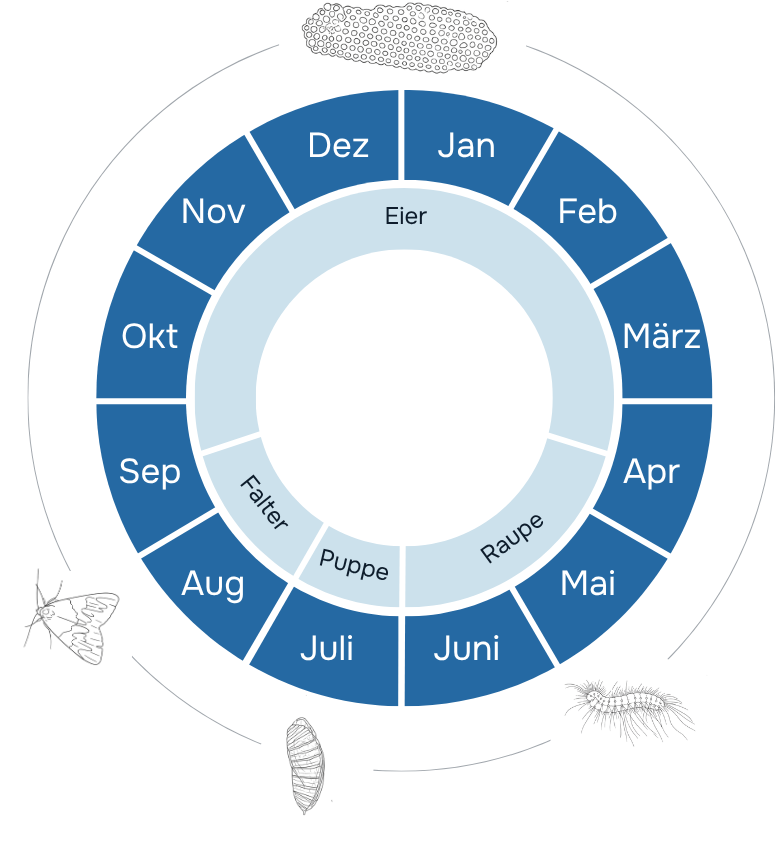
The oak processionary moth produces one generation per year. The moths emerge from August through September. Mating and egg-laying occur immediately after the female moth emerges. The eggs are laid in flat, hexagonal clusters in the crowns of oak trees. During the winter, the caterpillars overwinter as egg-stage larvae. The caterpillars then hatch from March through May and go through 5 to 6 larval stages. Starting in the third larval stage, they develop the stinging hairs that pose a health hazard, the number of which increases with each subsequent stage. The larvae pupate in July. Finally, the moths emerge again from August through September.
The Nighttime Processions
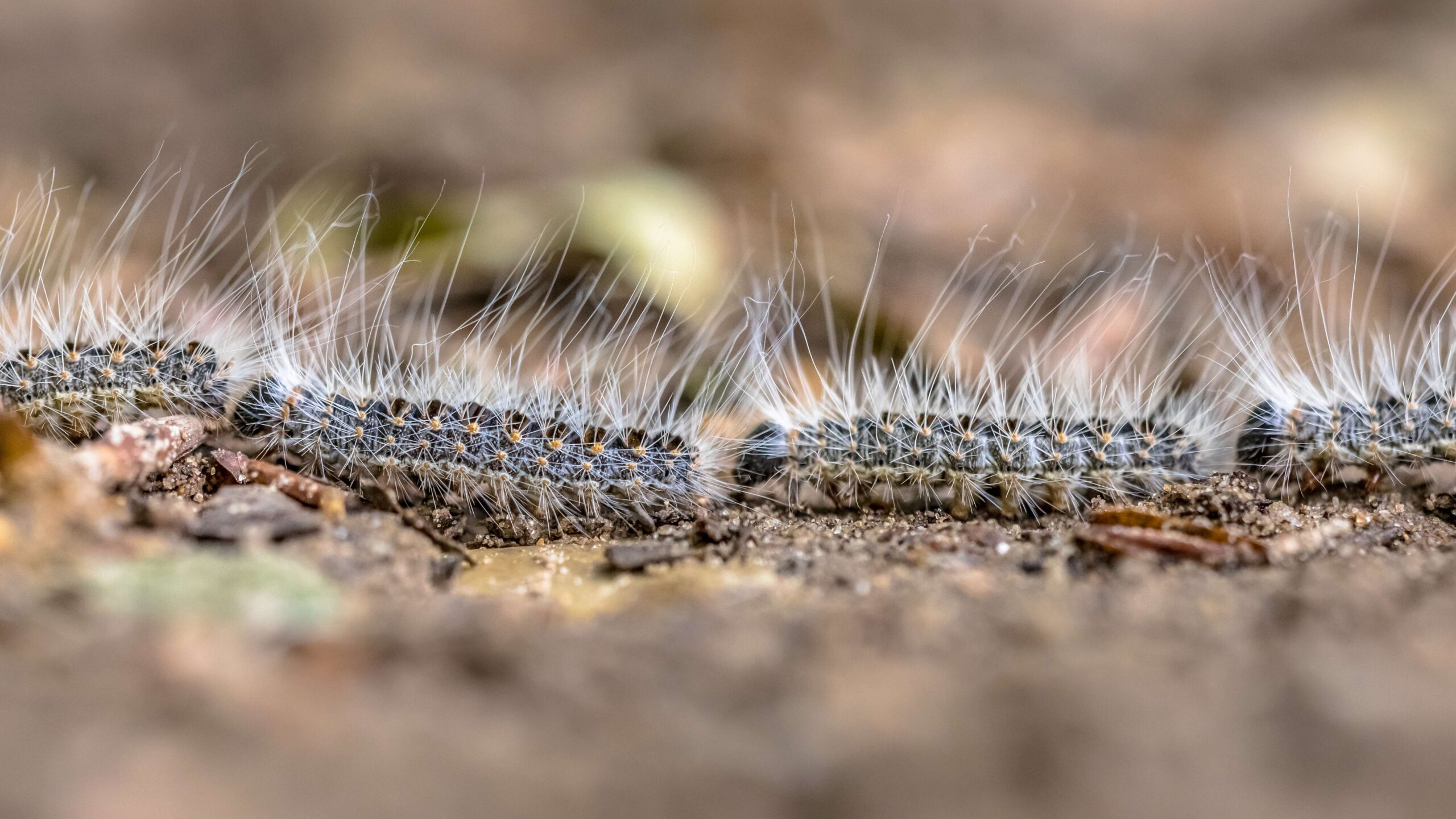
The oak processionary moth owes its name to its nocturnal foraging habits. Resembling a procession, the caterpillars form a tight line and march from their nests to the trees where they feed. Their heads remain in constant contact with the caterpillar in front of them; there is no sign of them straying from the line. The entomologist Jean-Henri Fabre (1823–1915) demonstrated just how far this strict obedience extends in an experiment. He short-circuited a procession into a circle around a 1.5-meter-tall vase. The caterpillars kept moving for several days until they were completely exhausted. And yet not a single caterpillar broke ranks.
Why is the population particularly large this year?
So-called mass outbreaks of the oak processionary moth can occur from time to time. Favorable weather conditions or the absence of natural predators contribute to this. A field guide from the year 2000 states that mass outbreaks can occur in some years—though they are generally rare and limited to specific local areas. In Berlin and Brandenburg in particular, it is no longer a matter of “some years”: for the past two years, a state of emergency has persisted there.
This year, a warm and dry April favored the proliferation of caterpillars. For one thing, the eggs develop better in this climate, and more caterpillars hatch. For another, the warm and dry climate also creates ideal conditions for their nightly foraging trips.
As drought conditions worsen and temperatures rise due to climate change, the oak processionary moth will spread more widely.
What are the consequences for the oak trees?
The caterpillars prefer to feed on oak leaves—and they do so voraciously. In the event of a severe infestation, the oak processionary moth causes what is known as defoliation of oak trees. If a tree is defoliated just once, it usually survives the complete loss of its leaves without any lasting damage. The problem arises only with infestations lasting several years. In such cases, the tree’s vitality declines drastically. The resulting weakened trees become more susceptible to pests and diseases.
Current Situation
Starting in mid-June, depending on the region and weather conditions, the caterpillar begins to pupate, and 3–5 weeks later, between July and September, the moth emerges.
According to the Baden-Württemberg Forestry Research Institute (FVA), the oak processionary moth has begun its flight there (as of late July).
As a moth, the oak processionary moth poses no danger to humans. The oak trees can also recover, because after feasting as a caterpillar, the moth no longer eats at all. Its only remaining task is reproduction.
Even though the oak processionary moth is no longer active as hairy caterpillars, the molted skins and webs continue to pose a significant health hazard. The toxic hairs remain on old caterpillar skins and in abandoned webs for years, are spread far and wide by the wind, and can trigger allergic reactions upon contact with animals and humans.