Gilching Relies on Tree Sensors
Heat and prolonged dry spells are posing an increasing challenge for municipalities: urban and street trees must be provided with sufficient water, while at the same time, the efficient use of water as a resource is becoming increasingly important.
The town of Gilching is therefore working with TreeSense to test how sensor data can help better understand the water balance of various urban trees and use those insights to inform maintenance and irrigation practices. The Süddeutsche Zeitung also reported on the pilot project in an article titled “The Trees Let Us Know When They’re Thirsty.”
Different Trees, Different Conditions
As part of the pilot project, five trees of different species, age groups, and locations are being monitored: two linden trees from 1950 and 2025, one Norway maple from 1990, and two mountain maples from 2005 and 2025.
The selection is deliberately diverse, as tree species, age, location, root zone, and planting conditions can all influence water supply and the tree’s response to drought. For young trees, for example, the study aims to examine how different planting conditions affect water balance.
At the same time, an old linden tree with known root problems is being monitored. The monitoring is intended to provide additional insights into the tree's water supply.
Monitoring the tree's water balance directly within the tree
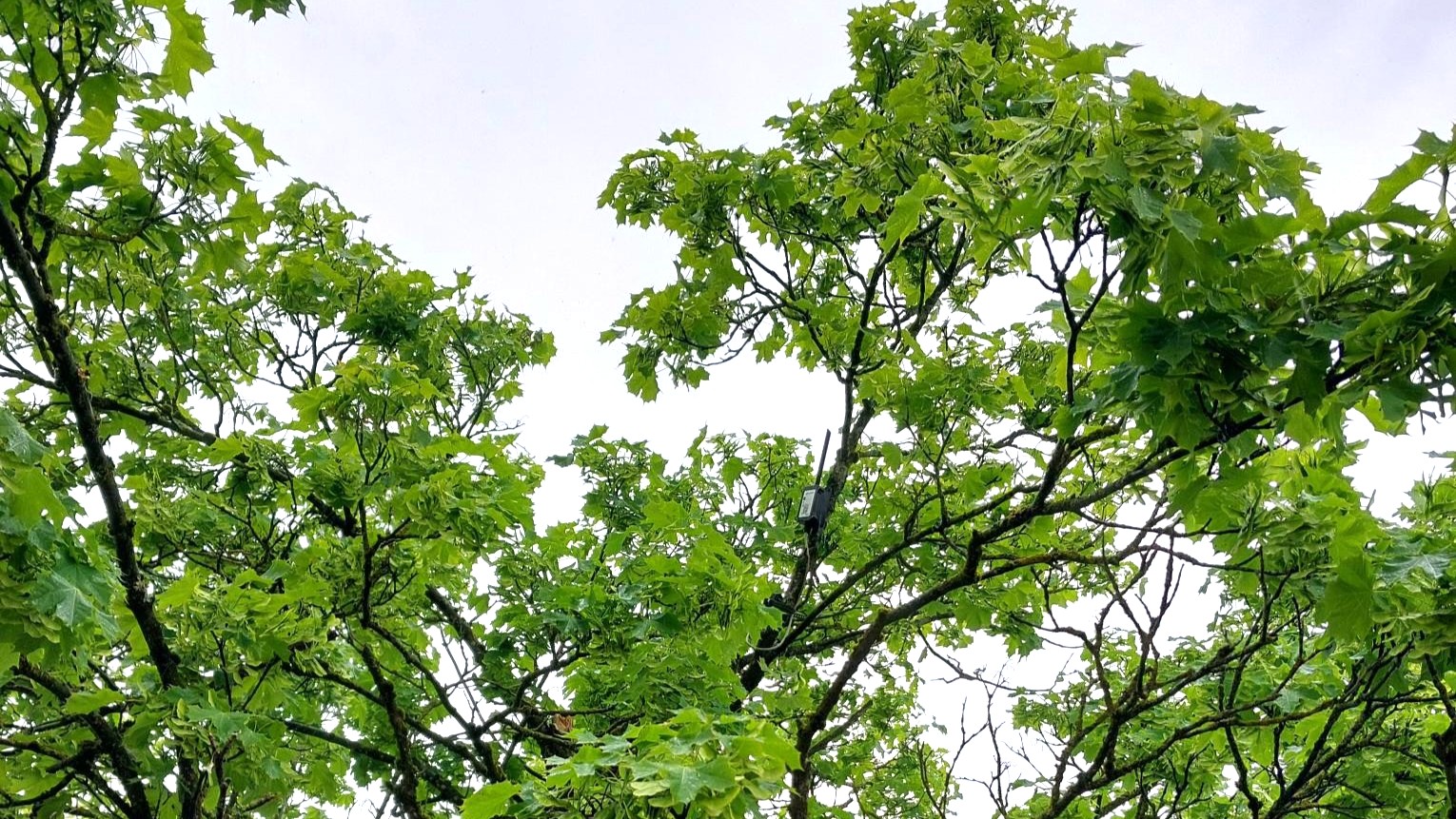
A total of six TreeSense Pulse sensors are used. They are installed in the tree crowns and continuously monitor changes in water balance.
This allows environmental planner Christine Hammel to observe in real time when drought stress is increasing, how individual trees react differently, and how their water status changes after rainfall or irrigation. The measurement data is transmitted digitally and processed in the TreeSense Cloud.
Water according to actual needs
Especially during prolonged dry spells, municipalities must decide which trees need water, when, and how often. Sensor data can provide an additional basis for decision-making. Instead of relying solely on fixed watering intervals, weather data, or empirical values, the tree’s actual response can be taken into account.
The goal here is not simply to water less, but to use water specifically where it is actually needed. This allows us to protect the trees while also making more efficient use of water, labor, and trips by the maintenance department.
What happens next?
It is particularly interesting to compare the different starting conditions. How does a tree planted as late as 2025 differ from one that has been established for decades? What impact do planting conditions have? And how does an older tree with root problems behave?
The collected data will be analyzed jointly by the municipality of Gilching and TreeSense. The goal is to gain insights that can be applied to practical tree care and irrigation.
The pilot project thus represents a step toward a more data-driven approach to managing the municipal tree population—with the goal of preserving trees in the long term and making targeted use of existing resources.