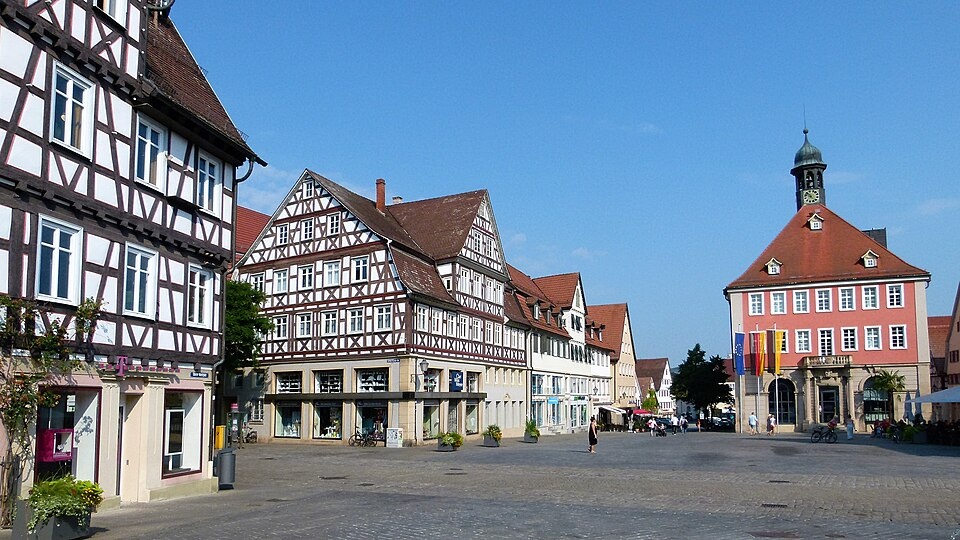
Schorndorf connects its trees
Digital sensors for sustainable urban greening
Schorndorf takes a consistently pragmatic approach to tree care: instead of blanket watering, the city relies on measurements that show actual needs. The goal is to reliably get young trees through dry periods, plan operations efficiently, and justify decisions transparently.
From assumption to certainty
The pilot project started in 2024 with five TreeSense Pulse sensors in the tree canopy and five Watermark soil moisture sensors in the root zone.
The combination was initially intended to map the entire water balance, from soil moisture to the tree's response. In practice, however, it became apparent that the crown data offered significantly greater added value.
After one year, the Watermark sensors were therefore replaced by five additional Pulse sensors, so that the project is now based exclusively on crown measurements, with stable data and high informative value.
Today, Schorndorf monitors exclusively with these sensors and reports stable values and high reliability.
The data is transmitted via NB-IoT and flows into the TreeSense Cloud, where it is visualized in real time. There, those responsible can see how the trees behave during droughts and when irrigation is really necessary.
Easily start implementation in existing systems, deepen knowledge in a targeted manner
The initial setup was straightforward. Installation on young trees (2–3 years old) was quick, while individual existing trees required a little more effort. All sensors were installed at representative locations in the city's new plantings, one sensor per tree, in order to reflect typical site conditions.
Feedback from practical operation was positive: installation is simple, and the data is plausible and comprehensible. This laid the foundation for adjusting maintenance routines without disrupting operations.
First effects in everyday life
The benefits are already apparent in the initial phase:
The teams in the Schorndorf urban greenery department, led by Marek Lihotan (Schorndorf Central Services), are reducing inspection trips and prioritizing trees where measurements indicate a need for action.
This means that watering routes are no longer planned according to a schedule, but according to need, and at the same time, there is a growing understanding of location differences: Where do trees retain moisture longer? Where does the crown react more quickly to drought stress?
What we learn and how to proceed
The combination of crown reactions and soil moisture values has provided valuable insights: in many cases, a glance at the tree canopy is sufficient for operational control.
Schorndorf is building on this:
The next step is to automate watering requirements to a greater extent, with irrigation orders to be generated directly from the TreeSense Cloud in the future.
In addition, forecast models based on historical measurements and weather data are planned in order to act even more proactively.
In the long term, mature trees should also be included more extensively in order to protect valuable stocks in a targeted manner and make urban trees resilient to climate stress.
Conclusion
Small pilot, big insights:
With ten pulse sensors, Schorndorf is creating a robust data basis that saves time and effort, focuses irrigation, and makes decisions measurable.
The approach has been deliberately kept lean at the outset—and is ready to grow step by step.
"Schorndorf shows how practical and reliable data-based tree care already is today," says Giancarlo Fodera, co-founder of TreeSense. "The city doesn't think in terms of sensors, but in terms of solutions—and that's exactly what makes the difference."