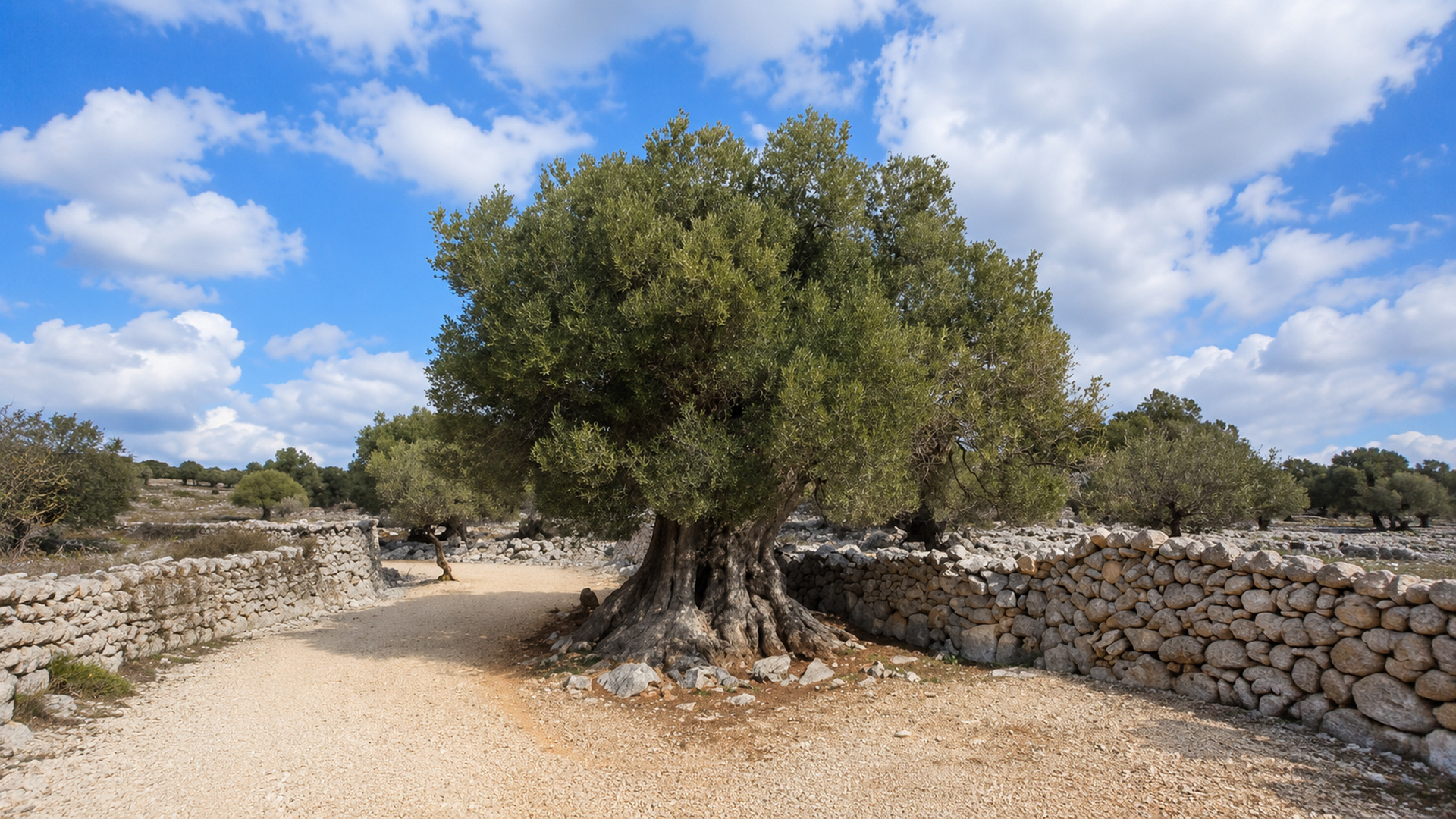
Greetings from the olive groves of Lun
Summertime is vacation time. The TreeSense team is on the road, bringing back fascinating stories about trees from their travels. This time, we’re heading to the Croatian Adriatic, to the island of Pag. In the very north, around the small village of Lun, grows one of the most extraordinary olive groves in the world. Some of these trees were already standing here when the Romans first set foot on the island.
A botanical reserve in northern Pag
About 80,000 olive trees grow on the narrow headland around Lun. Approximately 1,500 of these are wild olives (Olea oleaster), ranging from five to eight meters in height, with trunk diameters of 20 to 80 centimeters. This concentration of ancient wild olive trees in such a small area is unique worldwide. Comparable stands exist in only two other places: Greece and Israel. Because of its botanical significance, the area was placed under protection as early as 1963 and designated a botanical reserve.
The Oldest Olive Trees in the World
The age of an olive tree can be estimated based on its radius: As a rough rule of thumb, one millimeter of radius corresponds to about one year. Since it is virtually impossible to definitively determine the age of the oldest trees among some 80,000, the olive groves collaborate with agronomic institutes. The results confirmed so far indicate that two trees are approximately 2,000 and 1,600 years old. This makes them among the oldest olive trees in the world.
A Master of Survival Between the Cliffs and the Bura
What is particularly remarkable is where these trees grow. The karst soil around Lun offers hardly any usable soil, compounded by long dry spells, salty sea spray, and the bura, the cold downslope wind from the Adriatic Sea. Only the genotypes that can cope with these exact conditions have survived. Over the centuries, a stand of trees has developed that functions as a living archive of adaptation to drought, wind, and salt—the very same environmental factors that TreeSense deals with on a daily basis.
Every tree is unique
Unlike many cultivated olive trees, the trees in Lun did not grow from cuttings but from seeds. Over generations, the hardy wild olive trees were grafted with the native Oblica variety. DNA analyses reveal a high degree of genetic diversity in the grove, meaning that each tree is potentially a distinct variety. This gene pool is valuable not only from a cultural-historical perspective but also from a biological one.
A tree, not a bundle
To wrap things up, here’s a story that shows just how much these trees fascinate experts. For a long time, the thickest tree in the grove was thought to be a cluster of two or three olive trees that had grown together over the centuries. It wasn’t until a DNA analysis was conducted that the truth came to light: it is a single tree that has grown into this massive trunk over the course of about 2,000 years. A single organism that has stored two millennia of climate, drought, and wind in its growth rings.