
Holiday Greetings from Palo Verde
Summertime is vacation time. The TreeSense team is on the road and bringing back fascinating stories about trees from their vacations. This time, our journey takes us to Mexico, where our sales manager, Lena, came across the Palo Verde. It’s a tree that has found an inventive and clever way to cope with the heat.
The Iconic Desert Tree, the Palo Verde
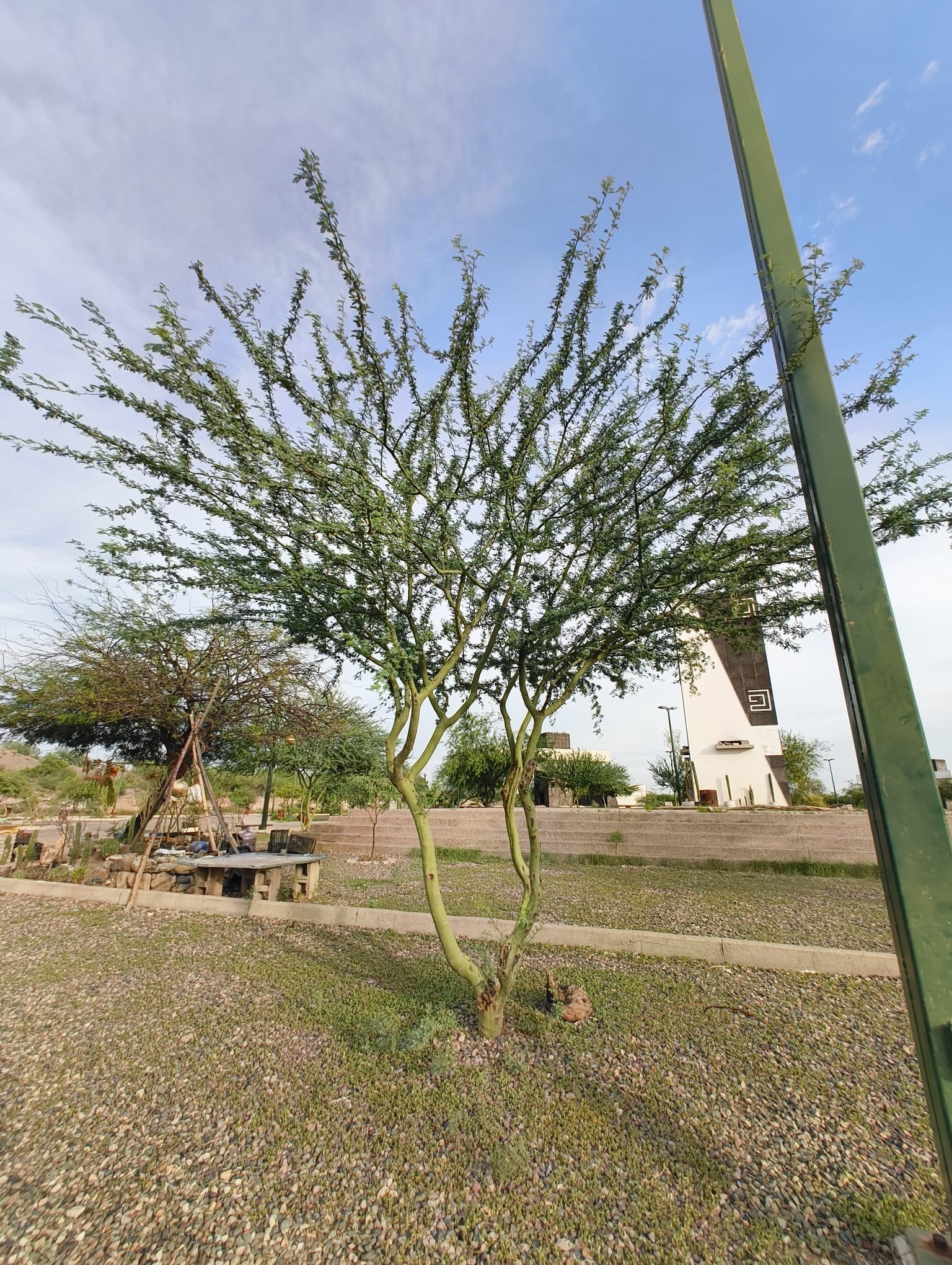
The Palo Verde is native to the arid regions of the southwestern United States and Mexico. Its name comes from Spanish and literally means “green stick”—a name that reveals its most distinctive feature: the green color of its bark. While most trees need their leaves to survive, the Palo Verde has developed a special ability: its bark performs photosynthesis on its own.
However, Palo Verde is not a single tree species, but rather a term used to refer to several species of the genus Parkinsonia. The best-known are: Blue Palo Verde (Parkinsonia florida), Foothill Palo Verde (Parkinsonia microphylla), and Mexican Palo Verde (Parkinsonia aculeata).
In Arizona, the Palo Verde is even the official state tree.
Adapted to Extreme Conditions
Depending on the species, the Palo Verde reaches a height of about 6 to 10 meters and forms an open, widely spreading crown. Its leaves are small and finely pinnate. During dry periods, the tree simply sheds these leaves, thereby conserving precious water. During these dry spells, the green bark takes over the entire task of providing energy. Only when the rains come and water is plentiful does the Palo Verde sprout new growth again.
The Spectacle of Colors in the Desert Spring
The distinctive, bright yellow color of the Palo Verde's flowers heralds the arrival of spring in the desert, when the tree begins to bloom in March and nearly its entire crown turns yellow.
The Palo Verde as a Witness in Court
But the Palo Verde has another story to tell—one that marked a turning point for molecular plant forensics in 1993. A woman’s body had been found a year earlier in the Arizona desert, surrounded by Palo Verde trees. One of the trees showed signs of impact damage, and two seed capsules were found in the suspect’s car. Genotyped using 47 RAPD markers, the seed capsules matched the damaged tree exactly—and differed from all other reference trees. These molecular results were accepted in court for the first time, and the suspect was subsequently convicted of murder.