World Water Day: Why Smart Irrigation Is Crucial Now
More than two billion people worldwide lack safe access to clean drinking water. But it’s not just in water-scarce regions that supplies are running low: even a water-rich country like Germany is increasingly feeling the effects of climate change. This is highlighted in a recent report by Tagesschau on World Water Day.
Less water, greater demand
Climate models show that even water-rich regions like Germany must prepare for increasing drought and heat. At the same time, water consumption is rising. Higher temperatures increase evaporation, and plants transpire more water due to longer growing seasons. When precipitation does occur, it often takes the form of heavy rain events, falls on parched or impervious surfaces, and does not seep into the groundwater as effectively. The consequences are less available surface water and reduced groundwater recharge, coupled with higher water demand—a water deficit.
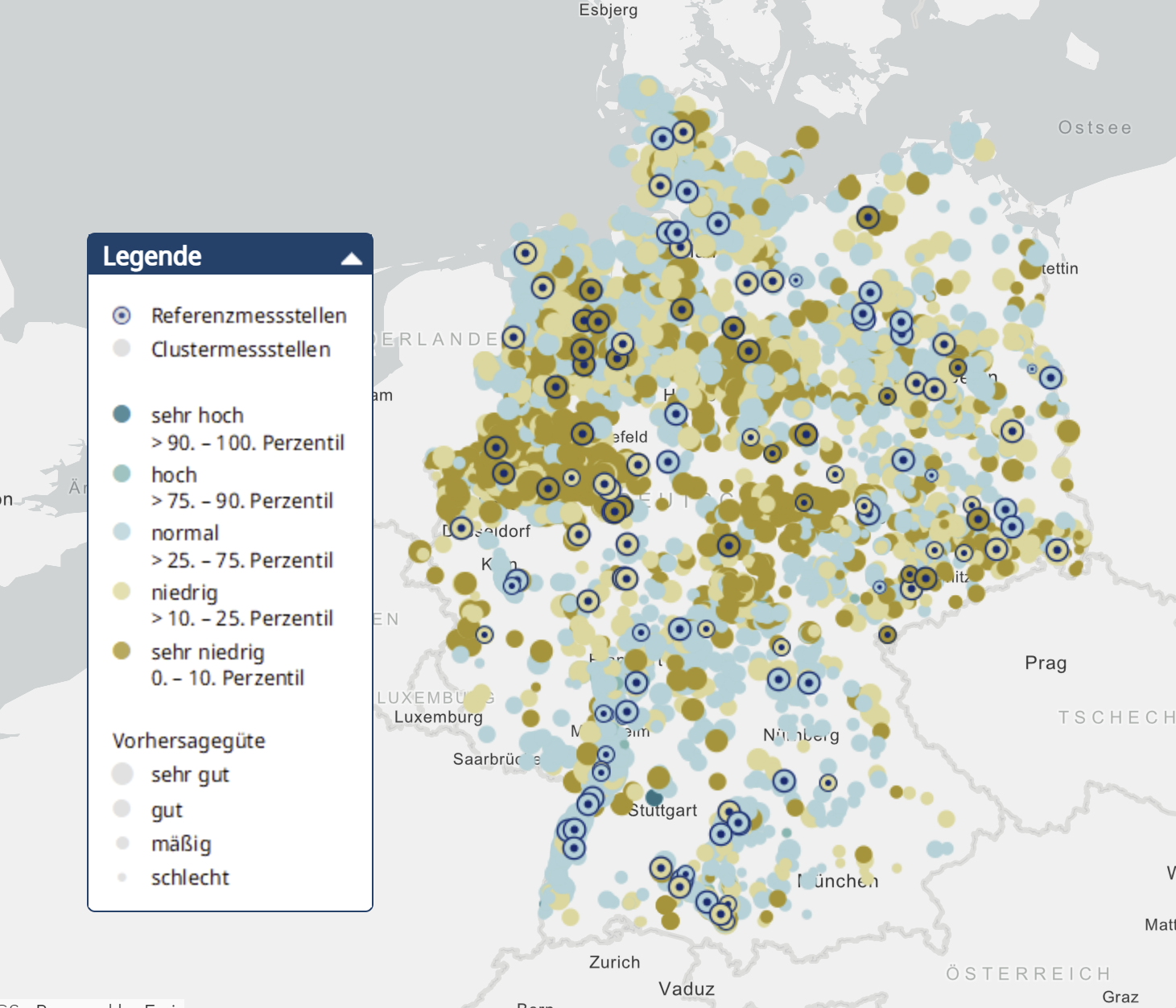
Screenshot of Federal Institute for Geosciences and Natural Resources: Groundwater level forecast for early April 2026 relative to the reference period of 1991–2020.
“Very high” means: the groundwater level at this monitoring site is higher than 90% of all readings recorded during the same calendar week in the years 1991–2020.
Trees need water—but how much?
Trees play a central role in the fight against climate change, as they absorb CO₂ and cool their surroundings. They must not suffer from water shortages, yet water must be conserved. The obvious solution—simply watering them less—does not work. It would jeopardize the vitality of trees and thus weaken the very organisms we urgently need in the face of climate change.
The Solution: Watering Based on Need
The answer lies in precision: providing water exactly when and in exactly the amount that each tree actually needs.
That is exactly what TreeSense makes possible. Sensors attached directly to trees or installed in the ground continuously monitor the water levels in the tree or soil. This data is used to generate precise watering recommendations. These recommendations are not one-size-fits-all, but tailored to specific needs. This is crucial because some trees are particularly thirsty, while others are less so. Some weeks require a lot of water, others do not. A one-size-fits-all watering schedule will never account for these differences.
The results: Water savings of up to 74 percent
Data from the TreeSense project with Schernthaner GmbH , for example, show that up to 74 percent of water usage could be saved compared to a standard irrigation rate of 100 liters per tree per week, without compromising the trees’ water balance.