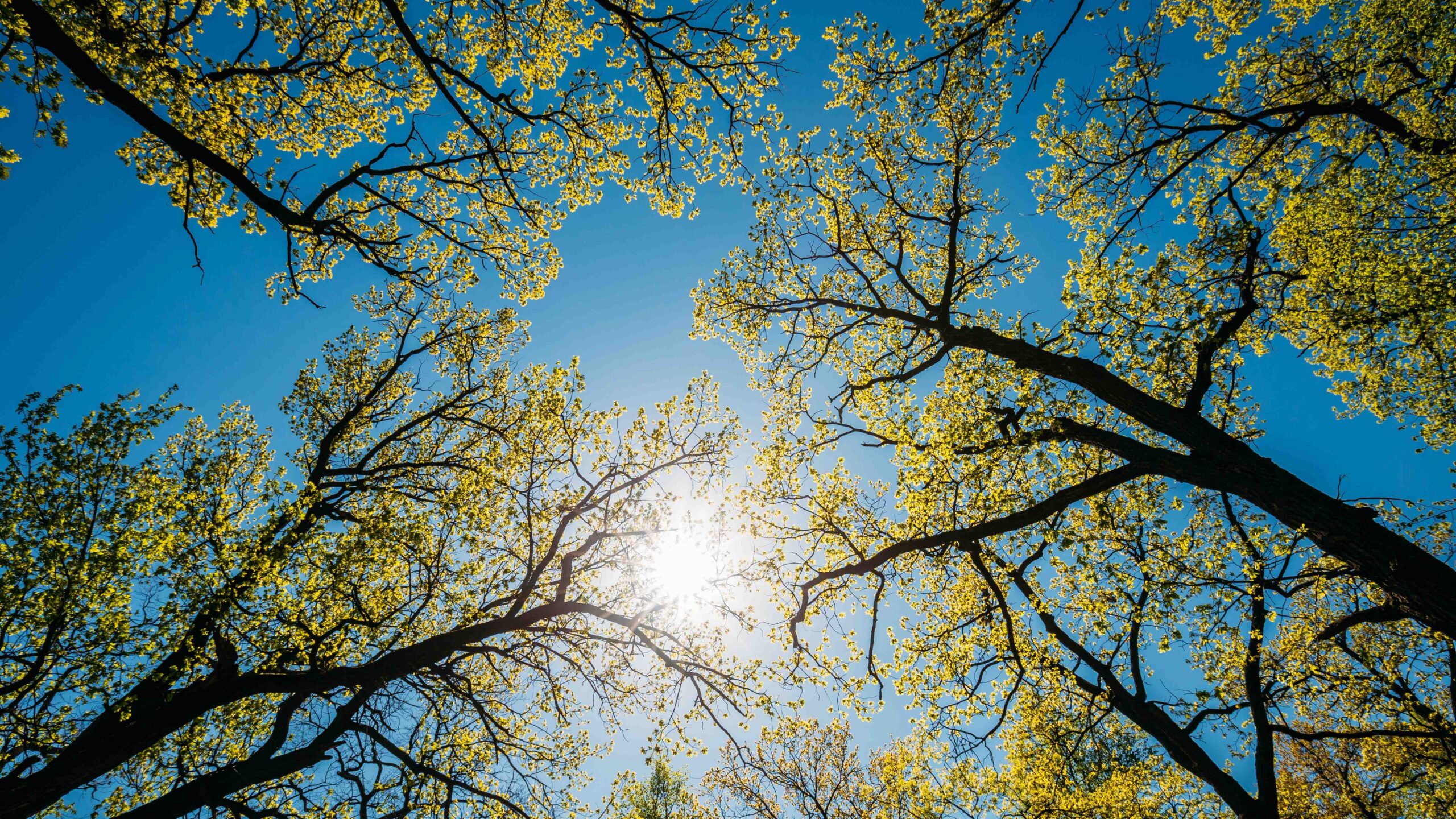
How do trees cope with the heat wave?
The heat wave had Europe firmly in its grip for just under two weeks. We’re currently enjoying a brief respite, but the next heat wave is already on the horizon in just a week, and the sweating will continue. These days, the importance of urban trees is not only a hot topic of discussion but also clearly felt: it’s bearable in the park with its natural shade. On the patio under the umbrella, however, we’re melting from the heat during our lunch break.
But how do trees cope with the heat? When do they reach their limits?
Trees are especially valuable to urban environments. That’s because they cool our cities in two ways: through shade and through evaporation. Just like us humans, trees use evaporation to protect themselves. To cool their leaves, trees release water through tiny pores—called stomata—onto the outside. This water evaporates, thereby cooling the leaf and its immediate surroundings. In this way, they manage to keep their leaves about 2–5 degrees cooler than the ambient temperature.
The Limits of Natural Air Conditioning
For a long time, it was assumed that trees would close their stomata at temperatures between 30 and 35 °C, thereby losing their cooling effect. A 2024 study by the Swiss Federal Institute for Forest, Snow and Landscape Research (WSL) shows that the plane trees studied evaporate water significantly longer and more intensively than previously thought. Even in extreme heat exceeding 39 °C, the trees continued to evaporate water and even increased their water flow, despite the air being very dry. The cooling effect of the foliage persisted longer under extreme heat than researchers had previously assumed. This is good news for the urban climate.
When Heat Meets Drought
However, the trees reach their limits when drought and heat occur simultaneously. A 2024 study by the Desert Botanical Garden in Phoenix examined two-year-old poplars. At an ambient temperature of 48 °C, the poplars were able to keep their leaves below 45 °C—the critical temperature at which leaves sustain permanent damage. However, they were only able to do so when they had an adequate water supply from the soil. As soon as the researchers reduced watering for 72 hours, the trees could no longer cool their leaves. The leaves became 3 degrees warmer than the outside temperature and suffered long-term damage. Even after watering was increased again, the leaves’ cooling effect did not recover.
Adequate Irrigation Through Monitoring
June 2026 was not only exceptionally hot but also exceptionally dry. In the future, it will become increasingly likely that periods of extreme heat will occur alongside extreme drought. As a result, it will become increasingly important to water trees sufficiently to ensure their survival and their cooling effect. At the same time, water itself becomes scarce, especially during such periods. With the help of sensors, we can determine more precisely when trees need to be watered and when they have enough water available. This allows us to keep the trees healthy, preserve their cooling effect, and still use the scarce resource of water sparingly.